



TAO Mooring Information
Current Mooring Configuration
The TAO array consists of 48 moored buoys in the Tropical Pacific Ocean, using six different mooring configurations. The locations of each buoy and its configuration are shown in the graphic below.
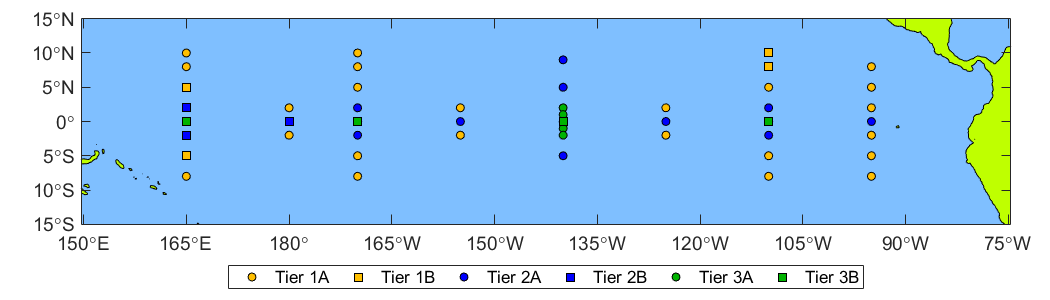
The sensors included in each configuration are listed below:
- Tier 1
- Wind speed and direction
- Air temperature
- Relative humidity
- Longwave radiation
- Shortwave radiation
- Barometric pressure
- Rainfall
- Sea surface temperature
- Sea surface salinity
- Ocean temperature at 5, 10, 15, 20, 25, 30, 40, 50, 60, 80, 100, 125, 150, 200, 250, 300, and 500 meters depth
- Water pressure at 300 and 500 meters depth
- Tier 2: All Tier 1 sensors, plus ocean current velocity at 8 meters
- Tier 3: All Tier 2 sensors, plus upward-looking acoustic Doppler current profilers at 75, 135, 195, and 255 meters depth
- Each tier has A and B designations. Tiers 1A, 2A, and 3A contain the sensors listed above. The “B” configurations contain additional subsurface salinity measurements at 5, 10, 15, 20, 25, 30, 40, 50, 60, 80, and 100 meters depth
Historical Mooring Configuration
Prior to the TAO Recapitalization, the TAO array consisted of 55 stations, including 51 standard stations and four Flux stations, so named because they provide additional observations that aid in the calculation of oceanographic heat and momentum fluxes.

The 51 standard moorings contained the following sensors:
- Wind speed and direction
- Air temperature
- Relative humidity
- Sea surface temperature
- Sea surface salinity
- Ocean temperature at 10 subsurface depths (exact depths vary by location)
- Water pressure at 300 and 500 meters depth
The four flux moorings contained all of the standard sensors, plus the following:
- Longwave radiation
- Shortwave radiation
- Barometric pressure
- Rainfall
- Ocean temperature at up to 16 subsurface depths
- Salinity at up to 7 subsurface depths
- Ocean current velocity at up to 5 depths
The four Flux stations also had an acoustic Doppler current profiler (ADCP) on a separate mooring. This sensor did not transmit its data to shore; the data were downloaded and processed following the recovery of the instrument.
The enhancements of the TAO Recapitalization make the additional Flux measurements standard across the entire array. ADCPs now transmit data in real-time and no longer require a separate mooring.
 NDBC on Facebook
 NOAA on LinkedIn
 NDBC on X